learn
plain answers about ai — privacy, video and images, making things, and how it all works. plus notes on using it well.
ai video & images
making cinematic clips with sound, animating stills, and what the other tools actually charge.
-
ai video & images · 4 min
one sheet, four rooms — using a location sheet in an ai video scene One image with four rooms in it is one reference that drags all four rooms into every shot. Split it into one reference per room and the scene stays in the room you asked for. Here is the whole flow, step by step. -
ai video & images · 6 min
AI animation video generator: template animators vs generated animation, and what each costs Two different products are called an AI animation video generator: template tools that assemble a cartoon from a character library on a subscription, and generated-video tools that render an animated look from a sentence or a still. Which one you need, where each falls down, the free tiers, and how to get an animated 8-second shot with its own voice for one credit. -
ai video & images · 5 min
AI anime video generator: the tools that hold the style, video-to-anime, and an anime shot with a voice AI anime video generators are three things: text or image to an anime clip (Vidu, Hailuo, Kling, Pika, nixm), video-to-anime style transfer (Domo AI), and anime stills you animate. Which holds the style, what each costs, the free tiers, and how to get an 8-second anime shot with a spoken line for one credit, no plan. -
ai video & images · 5 min
AI music video generator: the tools that sync to your song, and what generated video can do instead AI music video generators come in two kinds: tools that take your track and cut or generate visuals to its beat, and generated-video tools that make the shots but cannot hear your song. Which is which, what each costs, the free tiers, and an honest account of what a two-minute stitched sequence with a generated score (one more credit) can and cannot be. -
ai video & images · 4 min
AI commercial generator: what makes a real ad, the tools by job, and the per-shot route AI commercial and product video generators sorted by what they actually produce: URL-to-ad tools that assemble a spot from your product page, avatar tools for talking-head ads, and generated shots where your product sits in a real scene with sound. What each costs, where free stops, and how to make a 15-second spot shot by shot with no subscription. -
ai video & images · 4 min
AI photo to video, free, no sign-up: what actually renders without an account Which AI photo-to-video tools let you bring a picture to life without creating an account, where each free tier stops, the watermark and queue trade-offs, and the route that lets you upload your photo and plan the shot with no sign-up, then compose and render it with sound after a free sign-in, no card. -
ai video & images · 5 min
How to make a picture talk with AI: the three ways, and a five-minute walkthrough Three ways to make a photo talk: avatar tools that lip-sync a script to the face, animators that add motion and a voice, and generated video where the person in the picture says a line in a scene with sound. What each costs, the free tiers, how long a line can be, and a step-by-step for the no-subscription route. -
ai video & images · 3 min
AI dialogue generator: write the lines, then hear a character say them What an AI dialogue generator is good for, how to get lines that sound like people instead of a script, the free tools that do it without an account, and the one place you can take a finished exchange and hear a cast character perform it on screen with sound. -
ai video & images · 3 min
AI script generator: free options, what each is good for, and how to film what you get AI script generators by job: YouTube and marketing scripts, movie and screenplay drafts, and short scenes you intend to shoot. The free options with and without an account, the prompts that get a usable first draft, and the one route from a generated script to a performed shot with sound, no subscription. -
ai video & images · 4 min
Script to video AI: what the tools do with your script, and the one that performs the lines Script to video AI means three different things: stock footage cut to a voice-over, a presenter avatar reading your script, or generated shots where a character speaks the dialogue. What each kind costs, where the free tiers stop, and how to go from a page of script to a performed scene without a subscription. -
ai video & images · 3 min
HeyGen alternative: when you need a talking clip, not a subscription HeyGen sells presenter videos by the month: pick an avatar, paste a script, pay for minutes. If what you actually need is one short clip of a character saying a line, with sound, there is a per-clip route. The honest comparison, with what each does badly. -
ai video & images · 3 min
Synthesia alternative: free options, cheaper plans, and the per-clip route Synthesia is the enterprise avatar-video standard: presenters, scripts, minutes per month. The honest alternatives by need: free tiers, cheaper presenter tools, and a per-clip studio for when you need one short clip of a character speaking, with sound, and no plan. -
ai video & images · 3 min
AI video generator with no sign-up: what you can make before creating an account Which AI video generators let you make something before signing up, what you get at that point (length, resolution, watermark, sound), where every one of them puts the wall, and why the wall exists. How to get the most out of the no-account step, and the fastest route to a clean HD clip with sound after it. -
ai video & images · 4 min
AI video platform vs AI video model: what you are actually paying for An AI video platform is the workflow around the models: composing, casting a consistent character, sound, extending, sharing and paying. Which platforms exist, what each layer adds over calling a model directly, how pricing differs, and how to choose one for the kind of video you make. -
ai video & images · 4 min
Best AI model for film and movie generation: pick by the shot, not the leaderboard The best AI video model for film depends on the shot: dialogue scenes, action, long takes, consistent characters across cuts, native sound. How the current model families compare on each, where they fail, what a shot really costs, and why a film is a sequence of model choices rather than one. -
ai video & images · 2 min
Dreamina free credits: the daily grant, Seedance access, and when free ends How Dreamina's free credits work: the daily grant, what a Seedance video costs in credits, the watermark and queue on free renders, which models the free tier can reach, and the walls people hit. Stretching the grant, what the plans change, and pay-per-clip for the shots the grant did not cover. -
ai video & images · 2 min
Hailuo free credits: daily points, what they buy, and what to do when they run out How Hailuo AI's free tier works: the daily point grant, what a clip costs, the queue and watermark on free renders, and what the newer models and longer clips require. How to make the free points last, what the subscriptions change, and the pay-per-clip route for the shots after the grant. -
ai video & images · 2 min
Higgsfield free credits: the daily grant, what presets cost, and where free stops How Higgsfield's free credits work: the daily grant, what its camera-move presets and effects cost, the watermark and queue on free renders, and the point where the free tier stops being useful. How to stretch the credits, what the plans change, and pay-per-clip for the shots after. -
ai video & images · 3 min
Kling free credits: what they buy, when they run out, and what to do then How Kling's free credits work: the daily grant, what one clip costs in credits, the queue and watermark you get on the free tier, and the walls people hit mid-project. How to stretch them, what the paid plans change, and the pay-per-clip alternative when you need one more shot without a subscription. -
ai video & images · 2 min
Pika free credits: what you get, how fast they go, and what to do after Pika's free credits explained: the grant, the per-clip cost, what the free tier locks (newer models, longer clips, no-watermark downloads), and the moment most people hit the wall. How to stretch the credits, what the subscriptions change, and when paying per clip is the better deal. -
ai video & images · 2 min
PixVerse free credits: what the daily grant buys, and the way around the wall How PixVerse's free tier works: the daily credit grant, what a clip and an effect cost, the watermark and queue on free renders, what the newer models and longer clips require, and the three places people get stuck. Stretching the grant, what the plans change, and pay-per-clip when you need shots now. -
ai video & images · 3 min
Runway free credits: the one-time grant, what it buys, and the wall everyone hits Runway's free plan explained: the one-time credit grant that does not renew, what a few seconds of video cost in credits, the watermark, the export limits, and why the free tier ends faster than any other. What the paid plans change, and the pay-per-clip alternative for people who do not render every day. -
ai video & images · 2 min
Vidu free credits: what the grant buys, and what comes next How Vidu's free credits work: the grant and its reset, what a clip costs, the watermark and queue on free renders, whether the reference-to-video features work on the free tier, and where people get stuck. Stretching the grant, what the plans change, and the pay-per-clip route when you need more. -
ai video & images · 6 min
AI book trailer from your book cover — what one render really is We asked an AI video tool for a 60-second book trailer from a cover. It wrote a good script and rendered 8 seconds. What a render actually is, how to get your cover on screen, and how to build the trailer shot by shot. -
ai video & images · 4 min
Put your logo in an AI video — one scene where the brand held A real 10-second AI video scene with a cast character and a logo bound as a prop: the mark lands on the cup, as the image, in every frame. What was asked, what the engine needs, and why it used to come back as the text "#Image1". -
ai video & images · 4 min
Animate old photos with AI — gently, and honestly How to animate an old family photo with AI: face-animation apps vs image-to-video, how to scan and crop for the best result, prompts that keep it gentle, what the model invents, and why your upload shouldn't live forever on someone's server. -
ai video & images · 4 min
A Christmas video greeting from one photo Turn one family photo into an eight-second Christmas video card: snow starting, a wave, a "Merry Christmas" in the clip's own sound. How to prompt it, what works and what doesn't, and how to send it — first HD video free on nixm. -
ai video & images · 4 min
AI lip sync video in 2026: what a spoken line does on nixm, from two clips Two real AI video clips with spoken lines, made the same week with the same character, side by side: a five-word line and a nine-word line after a cut. What was asked, what came back, and what seems to make the difference to how a line lands on the lips. -
ai video & images · 5 min
Free AI video generators in 2026 — what's actually free, and the catch Which AI video generators are really free in 2026, what each kind of free tier takes away (watermarks, commercial rights, resolution, queue time), which big assistants stopped making video, and the honest way to make a clip you can actually post. -
ai video & images · 5 min
we did the math against runway and kling — and we lose on $/second We published the table with our loss in it. Runway and Kling beat us on dollars per second of video. Here is the math, and the four places the subscription number stops being true. -
ai video & images · 5 min
the t-shirt and the car — what an ai video model quietly drops We spent a week getting three women, one t-shirt and a car into fifteen seconds. Here is exactly what the engine dropped at each step, why, and the two habits that stopped it. -
ai video & images · 2 min
magic hour alternative — when you want one great clip, not a hundred tools Magic Hour bundles dozens of AI tools into a cheap subscription. When the toolbox is worth it, what the credit math hides, and the pay-per-clip alternative. -
ai video & images · 3 min
chatbot video creator — direct a video by talking, not prompting What a chatbot video creator actually is, why composing a shot in conversation beats a prompt box, and how to direct an HD clip with sound by talking. -
ai video & images · 3 min
ai movie trailer — the one film form ai is actually built for A trailer is the one film form built from disconnected striking shots — which is exactly what AI video is good at. The shot list, how to handle the voice-over, the sound, and the real cost per clip. -
ai video & images · 3 min
can claude make videos? no — and here is what people do instead Claude, Fable 5.1 included, doesn't generate video on any plan. How people go from a drafted shot to a real clip with sound in about two minutes. -
ai video & images · 4 min
Google Flow: what the free credits buy, what each plan adds, and when to pay per clip instead Google Flow gives everyone 50 credits a day, about two 8-second 720p clips. What Pro and Ultra add, what Omni and Veo cost per clip, and the pay-per-clip way. -
ai video & images · 5 min
Meta AI video generator in 2026: what Vibes makes, what it costs, and when you need something else Meta's AI video generator is Vibes, inside the Meta AI app and meta.ai, where you animate an image, edit a clip and post it to a feed. Meta's help pages name no price for it, and a video you edit is capped at 10 seconds. What it makes, where your prompts go, and when you need something else. -
ai video & images · 4 min
an ai video generator without credits — what you're really getting Tools advertising no credits still meter you — by minutes, renders, queue position or a monthly plan. What each model actually costs, and when credits are the honest option. -
ai video & images · 4 min
Gemini Omni: what it makes, where to use it, and what each route costs Gemini Omni, Google's video model: clips with sound from text, images or a video you edit by talking. Free in Flow, plan-only in the Gemini app. Costs by route. -
ai video & images · 5 min
AI storyboard generator: from a script to a board to the shots Generate a storyboard with AI from a script or a one-line idea: one still per shot, in one style, in one conversation. Then animate the shots that work into HD clips with sound, from the same board. -
ai video & images · 2 min
video-to-video vs image-to-video — which one do you want? Video-to-video restyles footage you already have. Image-to-video animates a still. Which one you actually want, and which tools do which. -
ai video & images · 2 min
a2e alternative — what 30 free credits a day actually buys A2E gives 30 free credits a day, but image-to-video costs about 30 credits per clip and they expire nightly. The daily-credit math, and the pay-per-video alternative. -
ai video & images · 3 min
AI video extender: how to make a clip longer, step by step Extend an AI video about seven seconds at a time, with the sound carrying on. The steps, what each pass costs, and why two or three passes beat ten. -
ai video & images · 3 min
ai video for ads — promo clips without a production budget How to make short AI video ads that don't look generic — one product, one clear beat, native sound, and per-clip pricing so testing creative stays cheap. -
ai video & images · 2 min
open-source ai video — the real cost of running it yourself Wan, LTX, Hunyuan and the rest are free to download — the real cost is VRAM, setup and minutes per clip. What local AI video generation actually takes. -
ai video & images · 4 min
AI video for TikTok and Shorts — vertical, loud, and yours Making AI video for TikTok, Reels, and YouTube Shorts: the 9:16 workflow, why sound-in-one-pass matters, what stops the scroll, and the pay-per-clip economics of posting daily. -
ai video & images · 4 min
How long can AI videos actually be in 2026? Typical AI video lengths in 2026: most models render 5-15 second clips, the newest up to 30, and longer pieces are edited sequences of short generations. Why the limits exist and how to work with them, not against them. -
ai video & images · 2 min
Grok Imagine — video generation with a subscription attached Grok Imagine generates short AI video inside the Grok and X apps — gated behind X's subscription tiers. How it works, the subscription math, and the pay-per-video route. -
ai video & images · 2 min
"Unlimited" AI video — the honest arithmetic Thousands search for unlimited AI video generators. Here's the honest arithmetic: what "unlimited" means in practice, where the limits hide, and when pay-per-video beats every subscription. -
ai video & images · 3 min
Can ChatGPT make videos? Not anymore — here's what happened ChatGPT's video generator was Sora, and OpenAI has shut it down: the app in April 2026, the API in September. What that means if you are looking for an OpenAI video generator, and where chat-to-video lives now. -
ai video & images · 6 min
Higgsfield AI: what you actually get, what it costs, and when to pay per clip instead Higgsfield AI sells credits for other companies' video models: $19, $59 or $129 a month; Free has no credits. What a clip costs, and the pay-per-clip option. -
ai video & images · 9 min
How to make an AI video — the whole workflow, honestly How to make an AI video in 2026: describe one moment, compose the frame, render it with sound, then extend it or keep the same character across shots. The full workflow, the mistakes that waste credits, and what a finished piece costs. -
ai video & images · 3 min
NotebookLM video — a document explainer, not a film camera NotebookLM turns your documents into narrated explainer videos — sometimes taking 30+ minutes. What it's actually for, its limits, and when you want a cinematic tool instead. -
ai video & images · 7 min
Short film with AI — how to hold a story together across shots Make a short film with AI video in 2026: hold a character, a light and a grade across shots, plan coverage, and cut it together. The honest workflow, no subscription. -
ai video & images · 3 min
AI slop — why the first render looks wrong, and what to do about it Why your AI videos look wrong, and the workflow that fixes it: judge the frame before you animate, re-roll cheaply, keep the one take that lands. No subscription. -
ai video & images · 7 min
Image to video AI — turn a photo into a clip, and what it costs Turn a photo or picture into an AI video clip with sound. What image-to-video actually does, a real still and the clip it became, what drives the cost, where the free options stop, and what a single clip runs. -
ai video & images · 10 min
Best AI video generators and models in 2026: the honest comparison Which AI video generator is best in 2026 depends on what you are making. An honest map of the generators, models and platforms by use case: cinematic clips with sound, motion, editing, free options, open source and same-character stories, with how each one really charges. -
ai video & images · 2 min
Can Grok make videos? Yes — fast clips, daily quotas, and the alternative Yes. Grok makes video through Grok Imagine, xAI's own model — fast, stylized, and since early 2026 paid-only, behind X Premium or SuperGrok with daily quotas that reset. What it really costs, and the pay-per-clip alternative. -
ai video & images · 2 min
Luma Dream Machine vs pay-as-you-go — the sound and the subscription Luma's plans start around US$30 a month, credits are opaque, and clips render silent. The pay-per-clip alternative with native sound — the honest math for 2026. -
ai video & images · 2 min
Pika vs pay-as-you-go — when the monthly credit bucket stops making sense Pika's credits reset monthly and commercial rights start at the Pro plan. If you generate occasionally, pay-per-clip is cheaper — the honest math for 2026. -
ai video & images · 4 min
Seedance 2.5 launched — but can you actually use it? Seedance 2.5 shipped July 31 2026 inside ByteDance's own apps, API still pending. What access really looks like from North America or Europe — and the pay-per-clip alternative that is open today. -
ai video & images · 2 min
Kling vs pay-as-you-go — when monthly credits stop making sense Kling sells monthly plans with credits that reset. If you generate occasionally, pay-per-clip is cheaper — the honest math, and where each approach wins in 2026. -
ai video & images · 5 min
Text to video with sound — how native AI audio actually works Text-to-video AI that generates the sound with the picture, not silent clips with music added later. What native audio can do, what it still gets wrong, how to prompt for it, and a real clip to hear. -
ai video & images · 5 min
How long does AI video take to generate in 2026? Minutes per clip, tool by tool A single AI video clip takes from under a minute to a few minutes to generate, and a longer format like a Gemini Notebook Video Overview can take more than 30 minutes. Four things set the time: the queue, the clip length, the resolution and the model. What each vendor publishes, tool by tool. -
ai video & images · 2 min
Runway vs pay-as-you-go — which AI video pricing fits you What Runway credits cost per clip, what happens when they reset, and the pay-per-video math — when the monthly plan wins and when per-clip is cheaper. -
ai video & images · 4 min
Sora is shut down. Here is where to make AI video now. OpenAI closed the Sora app in April 2026 and the Sora API in September. The seven places people actually moved to, what each costs, which ones need a subscription, and the one that charges per clip with no plan. -
ai video & images · 5 min
Veo 3 and Veo 3.1 without a Google account: every way in, and what to use instead Veo 3 and Veo 3.1 need a Google account and a paid plan, and since May 2026 the Gemini app runs Omni instead. Every way to reach Veo, clip lengths, what 3.1 added, and pay-per-clip video with sound and no Google account.
privacy & ephemeral ai
what ai tools keep, what they do not, and how to think out loud without leaving a trail.
-
privacy & ephemeral ai · 3 min
Claude not working? Down for everyone or just you, the six causes, and the fix for each Claude not working: how to tell an Anthropic outage from a problem on your side in thirty seconds, what the capacity, usage-limit, and something-went-wrong messages each mean, the fix for each, and what to use while it is down. -
privacy & ephemeral ai · 3 min
Copilot not working? Microsoft Copilot and GitHub Copilot, the causes, and the fix for each Copilot not working: first, which Copilot. Microsoft Copilot (Windows, Edge, Microsoft 365) and GitHub Copilot (VS Code, JetBrains) fail for different reasons. How to tell an outage from your side for each, the common causes, the fix for each, and what to use while it is down. -
privacy & ephemeral ai · 2 min
Grok not working? Down for everyone or just you, the five causes, and the fix for each Grok not working on X or grok.com: how to tell an xAI outage from a problem on your side, why Grok works on the web but not in the X app (or the reverse), the usage limits and paid features, and what to use while it is down. -
privacy & ephemeral ai · 3 min
Is ChatGPT down right now? How to check in thirty seconds, and what to do while it is Is ChatGPT down, or is it just you? The three places that answer in thirty seconds (the OpenAI status page, Downdetector, and one test from another device), the five things that look like an outage but are not, and what to do with the next hour while it is down. -
privacy & ephemeral ai · 4 min
AI novel generator: what actually works chapter by chapter, and the honest limits No AI novel generator writes a novel in one pass. What works is a story bible and chapter-by-chapter drafting with the right tool: Sudowrite, Squibler and NovelAI for the workspace, the big assistants for prose, and a no-account option for the planning you would rather not have stored. The method, the free options, and where each one breaks. -
privacy & ephemeral ai · 3 min
AI plot generator: premises, turns, endings and backstory, with prompts that work How to use an AI plot generator for the four things it is actually good at: a stack of premises to choose from, the turns that get a story from its opening to its end, an ending that lands, and backstory that stays off the page. The free tools with and without an account, and the prompts. -
privacy & ephemeral ai · 3 min
Free unlimited AI story generator: what unlimited actually means Every "free unlimited AI story generator" is unlimited in one of three ways: a template that costs nothing to run, an ad-supported tool with a rate limit, or a model on your own machine. Which is which, where each one stops, which ones keep your stories, and the no-account option that is honest about its limits. -
privacy & ephemeral ai · 5 min
AI story generator: the free ones compared, what each keeps, and the one you can film The AI story generators worth using in 2026, by what you want: quick generators for instant output, the big assistants for prose, fiction tools for long projects, and a no-account option that keeps no transcript. What each costs, what each stores about your story, the prompt that gets a real first draft, and how to turn a scene into a short film. -
privacy & ephemeral ai · 3 min
Claude free plan limits: how the limit works, and how to get more out of it What the Claude free plan actually limits: a rolling usage window measured in text processed, not messages, that shrinks at busy times. What spends it fastest, what the free plan does and does not include, what Pro changes, and what to do when you hit the wall mid-task. -
privacy & ephemeral ai · 3 min
Gemini free limits: what the free app caps, when it resets, and what a paid plan changes What the free Gemini app actually limits: one compute-based allowance that refreshes every five hours up to a weekly limit, where simple chat costs little and image and video generation cost most, a smaller context for long files, and features that can go unavailable at busy times. What counts, how it refreshes, what a Google AI plan multiplies, and what to use when you hit it. -
privacy & ephemeral ai · 4 min
AI Dungeon alternatives: free, private, and local options for text adventures The real alternatives to AI Dungeon, sorted by what you are leaving it for: NovelAI for story quality, KoboldAI and SillyTavern for running it yourself, Perchance for free and no account, and a no-sign-up option that runs a text adventure with no transcript kept. What each costs and what each keeps. -
privacy & ephemeral ai · 3 min
Character.AI not working? Down, overloaded, or just you Character.AI not working, not loading, or stuck on "chat error, please try again": how to tell an outage from peak-hour overload from a problem on your side, the five causes in order, what the common errors mean, and where to go for the next hour. -
privacy & ephemeral ai · 4 min
ChatGPT not working? Is it down, or is it you? ChatGPT not working, not loading, or not opening: the 60-second check that tells you whether OpenAI is down or the problem is on your side, the seven causes in order of likelihood with the fix for each, what each error message means, and what to use for the next hour when the work cannot wait. -
privacy & ephemeral ai · 3 min
Claude "overloaded" and "something went wrong": what each means and what to do Claude is overloaded, error 529 overloaded_error, or Claude says something went wrong: what each message means, how to tell an incident from a peak, why retrying immediately makes it worse, what works instead, and what to use for the next hour when the work cannot wait. -
privacy & ephemeral ai · 4 min
Is Gemini down, or not working just for you? The thirty-second check, the six causes, and the fix for each Is Gemini down? How to tell a Google outage from a local problem in thirty seconds when Gemini is not working, not responding, or missing from your phone, then the six causes in order of likelihood (account type, region, the Android assistant switch, extensions, a stale session, a limit), and what to use for the next hour. -
privacy & ephemeral ai · 4 min
AI art generator, free, no sign-up: which ones still work without an account The AI art and picture generators that run without creating an account, checked this month: what each gives you free, the watermark and style trade-offs, which ones keep your prompts, and where you can plan a frame in words with no sign-up at all. -
privacy & ephemeral ai · 2 min
AI generators with no sign-up: image, video, text and story The AI generators you can use right now without creating an account, by type: image, video, text and story. What each one gives you free, where it stops, and which ones keep what you typed. -
privacy & ephemeral ai · 3 min
AI story generator, free, no sign-up: the options that work Where you can write a story with AI right now without creating an account: what each option does, where the free tier ends, and which ones keep a copy of what you wrote. One keeps no transcript at all. -
privacy & ephemeral ai · 4 min
Character.AI alternatives: the best options by what you want, and what each one keeps The real alternatives to Character.AI, sorted by why people leave: fewer filters, better memory, a companion app, privacy, or the wish to put a character in a video. What each does well, what it costs, what it stores about your chats, and the one question to ask before you pour months of conversation into any of them. -
privacy & ephemeral ai · 2 min
"ChatGPT is at capacity right now": what it means, how long it lasts, what to use meanwhile The "ChatGPT is at capacity" message: why it appears, who gets through and who does not, how long the waits usually last, the things people try that do nothing, and the two that help. Plus what to use for the next hour when the work cannot wait. -
privacy & ephemeral ai · 3 min
ChatGPT message limit: how the caps work, when they reset, and how to work around them ChatGPT's message limits explained without the moving numbers: how the free tier is capped, how Plus caps the better models in rolling windows, what happens when you hit one (the silent model switch), why the counts change month to month, how to see where you stand, and how to plan work so a cap does not land mid-task. -
privacy & ephemeral ai · 2 min
ChatGPT "Something went wrong": the six causes, and the fix for each The ChatGPT "something went wrong" error and its variants ("while generating the response", "please try reloading"): the six causes behind the same vague message, how to tell which one you have in thirty seconds, the fix for each, how to rescue a reply that died mid-sentence, and what the error says about where your work lives. -
privacy & ephemeral ai · 2 min
"Too many requests in 1 hour. Try again later." What it means, and what actually works The ChatGPT "too many requests in 1 hour" error explained: what counts as a request, why it hits free accounts and shared networks hardest, how long it really lasts, the three things to try in order, and what to do when you cannot wait. Plus the limits the message is telling you about. -
privacy & ephemeral ai · 3 min
Claude limits: usage limit reached, the 5-hour session, the weekly cap on paid plans, and how to get more Claude limits are a session-based limit that resets every five hours, and on paid plans a weekly limit on top. The usage-limit message explained: what counts toward the limit (it is tokens, not messages, so long documents and long chats spend it fastest), when each one resets, why free and paid tiers differ, the four habits that stretch it, and what to do when you hit it mid-task. -
privacy & ephemeral ai · 2 min
Gemini "Something went wrong": the five causes, and the fix for each The Gemini "something went wrong" error and its cousins ("try again", "I cannot help with that right now"): the five causes behind the same message, a one-minute diagnosis, the fix for each, the Workspace and region cases people miss, and how to rescue a reply that stopped halfway. -
privacy & ephemeral ai · 4 min
Privacy-first AI: a test for the label, and the tools that pass it "Privacy-first AI" is on every landing page now. A plain test for whether a product means it: what it stores, for how long, who can read it, whether it trains on you, and whether you can use it without an identity. The tools that pass each part, the ones that pass none, and where nixm sits. -
privacy & ephemeral ai · 4 min
Zero data retention AI: what it means, who offers it, and what it does not cover Zero data retention is an API term that is leaking into consumer marketing. What it means precisely, who really offers it (enterprise API agreements, some routers, a few privacy proxies, local models), what it does not cover, and how to read a privacy policy for the retention clock. Plus the honest version of what nixm keeps. -
privacy & ephemeral ai · 5 min
ChatGPT alternatives in 2026: the best free, private and specialist options, sorted by what you need The best ChatGPT alternatives in 2026, sorted three ways: free, private and specialist. Grouped by why people leave: a bigger free tier, no sign-up, chats that are not kept, or a tool that is better at one job, such as writing, search with sources or a model you run yourself. What each one does well, what it costs, and the one question to ask any of them before you type something personal. -
privacy & ephemeral ai · 3 min
How to delete Gemini history, and what Google keeps anyway Step by step: delete a single Gemini chat, clear all Gemini history, turn off Gemini Apps Activity so new chats are not saved, set auto-delete, and what Google says it keeps afterwards, including the reviewed-conversation window. Plus the setting most people miss and what to use when you want nothing saved at all. -
privacy & ephemeral ai · 3 min
How to share a ChatGPT conversation, and what the link gives away Share a ChatGPT chat in three clicks, what the other person can and cannot do with it, how to delete the link, and a way to share a conversation they can continue. -
privacy & ephemeral ai · 3 min
ChatGPT archived chats — hidden, not gone Archiving a ChatGPT chat only hides it: per OpenAI, archived chats stay in your account until you delete them. Where to find them, how to unarchive or delete them, what "delete all" covers, and the 30-day deletion window. -
privacy & ephemeral ai · 4 min
Can you use ChatGPT without logging in? You can use ChatGPT without an account. You lose chat history, data export, shared links and custom instructions, and OpenAI still trains on the chat by default. What works, what does not, and the no-sign-up alternatives. -
privacy & ephemeral ai · 6 min
ChatGPT says the conversation is too long — what that means and what to do ChatGPT stops a chat when the conversation hits its context limit. Why it happens, what you lose when you start a new chat, how to carry the context over with a handoff summary, and the habits that make it happen less often. -
privacy & ephemeral ai · 3 min
Is Brave Leo private? What Brave keeps, what stays on your device Brave says Leo stores no prompts or replies on its servers, doesn't train on your chats, hides your IP behind a proxy and needs no account. What that covers, where your chat history actually lives, the Claude and GPT models it hosts, and the feedback exception. -
privacy & ephemeral ai · 4 min
Is Proton Lumo private? What it keeps, what it encrypts, and what it can't Proton's Lumo keeps no logs, doesn't train on your chats, runs open-source models on Proton's own servers in Europe, and encrypts saved history so Proton can't read it. What zero-access does and doesn't cover, guest mode, and when you'd want no history at all. -
privacy & ephemeral ai · 4 min
AI privacy concerns — the real risks, and what to do about each The AI privacy concerns that actually matter in 2026: training on your chats, long retention, human review, court orders, ads, public share links, work accounts and where data is stored. Each with real examples and the setting or habit that addresses it. -
privacy & ephemeral ai · 4 min
ChatGPT data leaks — what actually happened, and what it means for you A running list of every real ChatGPT leak and data exposure: the 2023 history bug, the shared-chats-in-Google episode, the court-ordered retention, and the rest. What was exposed each time, and how to use AI so there is less to leak. -
privacy & ephemeral ai · 3 min
ChatGPT privacy settings — every control that matters Every ChatGPT privacy setting worth changing in 2026: model training, temporary chat, memory and chat-history references, shared links, archived chats, deletion, data export, ad personalisation and connected apps. Where each one is, and what it actually does. -
privacy & ephemeral ai · 3 min
Does ChatGPT sell your data? OpenAI says it does not sell personal data or share your conversations with advertisers. Since ads arrived in 2026, its privacy policy also describes ad personalisation and sharing with marketing partners. What that means, plainly, and how to opt out. -
privacy & ephemeral ai · 4 min
How to delete your ChatGPT history — every part of it How to delete one ChatGPT chat, every chat, archived chats, saved memories, shared links and your whole account, step by step, plus what deletion really does: the 30-day window, what survives, and why deleting a chat does not delete its memory. -
privacy & ephemeral ai · 3 min
Is AI safe to use? Mainstream AI chatbots are safe to use for everyday tasks. The real risks are privacy, wrong answers, scams and over-reliance. What each one looks like in practice, which assistants keep what, and five habits that make any AI safer. -
privacy & ephemeral ai · 3 min
Is Gemini safe to use? Gemini is safe in the malware sense and not private by default: chats are kept, some are reviewed by humans and retained up to three years. What is safe, what to switch off, and when to use something that keeps no transcript. -
privacy & ephemeral ai · 3 min
Is Character.AI private? What happens to your chats Character.AI chats are not end-to-end encrypted: they are stored, staff can access them for safety and legal reasons, and its policy lists training its models among the uses. What that means for roleplay and personal conversations, and how to limit it. -
privacy & ephemeral ai · 3 min
Is Meta AI private? What Meta does with your chats Since December 16, 2025, Meta uses your conversations with Meta AI to personalise ads and content across Facebook, Instagram, WhatsApp and Messenger, with no full opt-out. What that covers, what is excluded, and what the Discover feed taught people. -
privacy & ephemeral ai · 3 min
Is Perplexity private? What it keeps, and the setting that decides training Perplexity keeps your threads until you delete them and, on Free, Pro and Max, uses your searches to train its models unless you turn off AI data retention. What Incognito changes, what the 2026 lawsuit alleges, and how Enterprise differs. -
privacy & ephemeral ai · 15 min
the thread kept growing. the signal held. We ran the same kind of conversations two ways, twice: the full transcript every turn, or an intent plus a running log. The thread's context kept growing; the signal's stayed flat out to turn 40. Where each won, and what it costs. -
privacy & ephemeral ai · 5 min
Is ChatGPT private? What OpenAI keeps, and what it does with it ChatGPT keeps your chats until you delete them, can train on them unless you switch it off, and on free plans can use them to pick the ads you see. What each setting really controls, what temporary chat changes, and what deleting does. -
privacy & ephemeral ai · 4 min
Is ChatGPT safe to use? The four risks that actually matter ChatGPT is not malware and the official app is safe to install. The real risks are quieter: confident wrong answers, what you paste into it, fake ChatGPT apps and sites, and what you let it connect to. How to use it safely, and for teens. -
privacy & ephemeral ai · 4 min
Is DeepSeek safe? It depends which DeepSeek you mean DeepSeek's own privacy policy says your chats are stored in China, kept for as long as you have an account, and used to train its models. What that means, why governments restricted it, and how running the open model yourself changes the answer. -
privacy & ephemeral ai · 5 min
Is Grok private? What SpaceXAI keeps, who can read it, and what X changes Grok keeps chats until you delete them and trains on them unless you switch it off. What Private Chat (the ghost icon) really does, and the setting to change. -
privacy & ephemeral ai · 4 min
Is Claude private? What Anthropic keeps, and for how long Claude keeps your chats in your account until you delete them, and one privacy setting decides whether Anthropic can train on them and keep a de-identified copy for up to five years. What each choice means, what incognito changes, and what deleting actually does. -
privacy & ephemeral ai · 5 min
Is Microsoft Copilot private? Two apps, two sets of rules Since August 18, 2026 there are two consumer Copilot apps with two sets of privacy rules. What each one keeps, where your chats feed personalised ads and Bing, what the old app said about training and human review, and why work accounts are different again. -
privacy & ephemeral ai · 5 min
Is Gemini private? What Google keeps, who reads it, and for how long Chats saved 18 months by default, some read by human reviewers and kept up to 3 years after you delete. The setting that stops it, and what it doesn't. -
privacy & ephemeral ai · 5 min
What can ChatGPT Enterprise and Business admins actually see? On a company ChatGPT workspace, your conversations are company records. What Enterprise and Business admins can actually access, what the Compliance API carries, why temporary chats are not a hiding place, and what the usage dashboard does not show. -
privacy & ephemeral ai · 7 min
What each AI chatbot keeps One table: what ChatGPT, Claude, Gemini, Copilot, Grok, DeepSeek, Duck.ai, Lumo, Brave Leo and nixm each retain, for how long, whether deleted means deleted, and what the training default is. Sourced to each vendor, dated, and updated monthly. -
privacy & ephemeral ai · 7 min
Private AI chatbot: the most private options in 2026, ranked by what they keep A private AI chatbot keeps as little as it can: no account to start, no transcript, no training on your chats, a short stated retention. Anonymous, encrypted, no-retention, or local — five AI chat tools each win on a different definition of private. Lumo, Duck.ai, Brave Leo, Venice, running your own model, and the one that never stores a transcript at all. -
privacy & ephemeral ai · 3 min
ChatGPT record mode: where does the recording go? Record mode turns audio into a transcript and a canvas that stays in your chat history — and that ChatGPT can reference in later conversations. What OpenAI documents, and what it leaves you to arrange yourself. -
privacy & ephemeral ai · 4 min
Does ChatGPT keep the files and images you upload? Deleting the chat doesn't delete the photo. Where ChatGPT stores your uploads, the 30-day clock, and the separate step that actually removes them. -
privacy & ephemeral ai · 3 min
The case for a minimal AI interface Every setting an AI tool offers is a preference it has to store about you. The argument for interfaces that ask less — and keep less. -
privacy & ephemeral ai · 2 min
Does ChatGPT record your conversations? People asking whether ChatGPT records them usually mean something specific: is someone listening, is it training on me, can this be pulled up later. Three different answers. -
privacy & ephemeral ai · 3 min
How long does ChatGPT keep your chat history? Saved chats: until you delete them. Deleted and Temporary Chats: about 30 days. The 2025 court order that broke that clock, and where it stands now. -
privacy & ephemeral ai · 2 min
What data does ChatGPT store about you? Not just chats — account details, uploads, memory, device and usage signals. What actually accumulates behind an AI account, and what an AI that accumulates nothing looks like. -
privacy & ephemeral ai · 2 min
AI journaling without the data trail Popular AI journals are memory-first — entries stored, indexed, analyzed over months. The other model: journal with an AI that keeps no transcript at all, trace dissolving in 7 days. -
privacy & ephemeral ai · 2 min
AI thinking partner vs. therapist — the line, drawn honestly AI can be a genuinely useful thinking partner — and it is not therapy. The honest line between the two, why the distinction protects you, and when only a human will do. -
privacy & ephemeral ai · 2 min
The 5-minute brain-dump that dissolves behind you A simple evening routine: dump everything circling in your head into an AI that sorts it with you — then let the whole session dissolve. Five minutes, no transcript kept, repeatable forever. -
privacy & ephemeral ai · 2 min
Is your journaling app analyzing you? Mood graphs, theme detection, pattern tracking — the features that make AI journals feel smart all require reading everything you wrote. What analysis means for your archive. -
privacy & ephemeral ai · 2 min
Prompts for a tough day — in a room that saves nothing Seven prompts for writing out a hard day — designed for a room that keeps no transcript, where the honest answer is safe to write because no lasting record of it will exist. -
privacy & ephemeral ai · 2 min
An AI with no memory — feature, not bug Every AI company is racing to remember you harder. The case for the opposite: what memory actually costs, what forgetting buys, and when a blank-slate AI is the better tool. -
privacy & ephemeral ai · 2 min
Private journaling apps — what each model actually stores Every journaling app claims privacy — encrypted, on-device, passcoded. A plain map of what each model actually stores and where, and the one option that keeps no transcript at all. -
privacy & ephemeral ai · 2 min
A private space to think out loud — that keeps nothing Everyone needs somewhere to think unedited. Why AI is good at holding one end of that, why stored history ruins it, and what a room that keeps no transcript changes. -
privacy & ephemeral ai · 2 min
The case for ephemeral journaling Journaling advice assumes you keep the journal. A serious case for the opposite: writing that dissolves, why it produces more honesty, and what you actually lose. -
privacy & ephemeral ai · 2 min
Venting to an AI — here's what happens to the words Millions vent to AI after hard days. On most tools, the vent becomes stored history under your account. What actually happens to those words — and where they can happen without a record. -
privacy & ephemeral ai · 2 min
AI and privilege — the reality nobody's marketing department mentions AI chats carry no privilege — Altman said it plainly, the ABA warned about it, and courts proved it. What lawyers and clients get wrong, and what reducing the trail actually means. -
privacy & ephemeral ai · 2 min
M&A thinking with AI — what not to paste, and where to think Deal thinking leaks through tooling before it leaks through people. What M&A material should never enter stored AI, what generalizes safely, and where the modeling can live. -
privacy & ephemeral ai · 2 min
Sensitive decisions — brainstormed where nothing sticks The hardest decisions need the messiest thinking — and the messiest thinking least deserves a permanent record. A room for working out what you actually think, that keeps none of it. -
privacy & ephemeral ai · 2 min
Can your employer see your ChatGPT? Depends which ChatGPT Work account, personal account, work laptop, work network — each changes who can see your AI chats. The visibility map, honestly drawn, and the option outside all of it. -
privacy & ephemeral ai · 2 min
Layoff planning with AI — without the thinking becoming a record Layoff planning is the most leak-sensitive document work a leader does — and consumer AI stores every draft. How to think through a reduction without creating a record of the thinking. -
privacy & ephemeral ai · 2 min
Is ChatGPT confidential for work? Feels yes, is no It feels like a private conversation; it's a stored business record. The five confidentiality mistakes professionals make with AI, and the two-lane fix that ends them. -
privacy & ephemeral ai · 2 min
Negotiation prep — where your walk-away number shouldn't live Your walk-away number, your fallback positions, your read of the other side — negotiation prep is leverage, and stored AI history is where leverage goes to leak. Prep off the record. -
privacy & ephemeral ai · 2 min
HR drafts and AI — where the most sensitive text in the company goes PIPs, terminations, investigation notes — HR work is the most sensitive text in a company, and AI drafting files it to consumer chat history by default. Where it goes, and where it doesn't have to. -
privacy & ephemeral ai · 2 min
Can AI companies read your chats? Where the access really sits Who can actually access your AI conversations — company systems, reviewers, courts, breaches — and what changes when there is no stored conversation to access. -
privacy & ephemeral ai · 2 min
ChatGPT Temporary Chats — private from you, not from the server Temporary Chats hide conversations from your history — not from OpenAI's servers. The 30-day window, the court order that swept them up, and what actual ephemerality means. -
privacy & ephemeral ai · 3 min
Does ChatGPT save my conversations? Yes — here's the whole picture Yes — ChatGPT saves your conversations, and a federal court spent a year deciding what happens to them. What's retained, for how long, and what an AI that keeps no transcript looks like. -
privacy & ephemeral ai · 3 min
How to ask AI personal questions — privately, actually A practical, layered playbook for asking AI the personal stuff — what settings help, what they miss, what not to include, and the option where nothing persists at all. -
privacy & ephemeral ai · 2 min
How to use AI without it remembering you Practical steps to keep AI from accumulating a record of you — settings that help, their limits, and the one option where forgetting is the architecture. -
privacy & ephemeral ai · 2 min
Duck.ai — genuinely anonymous, differently private Duck.ai anonymizes who you are, not what persists. What DuckDuckGo's own docs say it strips and keeps, where your chats actually go, and what anonymity doesn't cover. -
privacy & ephemeral ai · 5 min
NYT v. OpenAI — how a copyright case became about your chats A copyright lawsuit turned into the biggest AI-privacy story of the decade: deleted chats preserved, 20 million conversations produced, and a July 2026 sanctions motion alleging logs were deleted anyway. -
privacy & ephemeral ai · 4 min
Private AI chat — no account, and as little kept as possible AI chat with no login, no account and no saved history: which tools let you talk without signing in, what each one still keeps, where the free use runs out, and how to pick one for the conversations you would not want in anyone's logs. Plus the honest version of what nixm keeps. -
privacy & ephemeral ai · 2 min
Relationship questions — thought through, not filed away People ask AI about their relationships constantly — and every question becomes account history. How to think through the personal stuff without a permanent record. -
privacy & ephemeral ai · 6 min
Ephemeral AI — when the conversation never becomes a record Ephemeral AI chat means no transcript is kept, and whatever the service does keep is small and ends on a fixed clock. How it differs from no-logs and incognito modes, what nixm keeps for seven days, and why the design exists. -
privacy & ephemeral ai · 2 min
What people delete from ChatGPT — and the better move than deleting Deleting AI chats after the fact is the most common privacy habit — and the weakest. What the delete-later reflex reveals, why it fails, and the ask-without-a-record alternative.
make things with ai
charts, mind maps, decks and quizzes, made in a conversation and kept in a signal.
-
make things with ai · 3 min
Free chart generator: type your numbers, get the chart, change it by talking A chart generator you talk to: type or paste your numbers, nixm draws the chart in the conversation, then change it by saying so. What is free, what costs a credit, step by step. -
make things with ai · 4 min
AI Christmas card generator: make the picture, the card and a video greeting, no subscription An AI Christmas card generator in 2026 is three different things: template tools (Canva, Adobe Express) that put your photo and words on a designed card, image generators that paint a picture from a sentence, and video greetings that make the picture move and speak. Which to use, which are free without an account, and how to make one card that does all three. -
make things with ai · 3 min
Midjourney free trial: none on the web or Discord, what Basic costs, and what is free instead Midjourney has no free trial on the web or in Discord, only a limited one in the niji·journey app. The cheapest way in is the Basic plan, $10 a month, on the web or in Discord. What that buys, the image generators that still make a picture for free with no account (checked November 2026), and a pay-per-image option with no plan. -
make things with ai · 3 min
AI flashcard generator: from your notes to question/answer cards, in one message An AI flashcard generator turns notes, a chapter or slides into question-and-answer cards. How Quizlet, Anki, Knowt and Brainscape handle it, how to get cards that actually test the material, and a generator that writes the cards in the chat as question/answer pairs, no account to start, with a study guide from the same notes. -
make things with ai · 4 min
AI homework helper: explains the step, checks your work, keeps no transcript An AI homework helper is a chat that explains the step you are stuck on and checks the answer you got, not a machine that does the assignment. How the apps differ (Brainly, Chegg, Gauth, Photomath, Khanmigo), how to ask so you actually learn it, and a helper you can use without an account that keeps no transcript of what you typed. -
make things with ai · 3 min
AI lesson plan generator: a plan in your format, revised in the thread, no transcript kept An AI lesson plan generator drafts a lesson from your objective, your material and your timing, in the format your school uses. How MagicSchool, Eduaide, Diffit, Brisk and Canva handle it, how to get a plan you would actually teach from, and a generator that drafts it in the chat without an account and keeps no transcript of your material. -
make things with ai · 3 min
AI test generator: from your material to a test with an answer key An AI test generator writes exam questions from the material you give it, with an answer key and a mark scheme. How Wayground (formerly Quizizz), Kahoot, Google Forms with Gemini, MagicSchool and QuestionWell handle it, how to get questions that match what you taught, and a generator that drafts the test in the chat without an account and keeps no transcript of your material. -
make things with ai · 3 min
AI worksheet generator: practice sheets from your material, differentiated, with a key An AI worksheet generator writes practice exercises from the material you teach, at the level you ask for, with an answer key. How MagicSchool, Twee, Diffit, Eduaide and Canva handle it, how to get exercises that match the lesson, and a generator that drafts the sheet in the chat without an account and keeps no transcript of your material. -
make things with ai · 4 min
AI resume builder: a resume in 20 minutes, without uploading your life to a template site How to use an AI resume builder properly: what to give it, the prompts that produce a resume a recruiter will actually read, how to tailor it to one job posting in a minute, the mistakes AI makes on resumes, and how to do the whole thing without handing your work history to a site that keeps it. -
make things with ai · 3 min
Best AI for essays: use it to think better, not to skip the thinking Which AI is best for essays and papers, and the way to use it that actually improves your mark: outlining, finding the counter-argument, feedback on your draft, citation checking and tightening. Why the paste-the-prompt-submit-the-output approach fails on quality before it fails on detection, and what to do instead. -
make things with ai · 5 min
Best AI for writing in 2026: essays, books, creative writing and work drafts, and what each one keeps The best AI for writing depends on the job: essays and coursework, a book, creative writing, or work drafts. A plain guide to which tool fits each, with Claude, ChatGPT, Gemini, Sudowrite and NovelAI compared on what they do best and what they keep, how to prompt any of them so the result sounds like you, and where to draft what you would not want kept. -
make things with ai · 5 min
AI collaboration: two people, one AI, and no transcript between them Human-AI collaboration usually means one person and a chatbot. Here is what it looks like with two people, one AI and no shared transcript: each person talks privately, the work is shared, the decisions stick. -
make things with ai · 5 min
AI image generator, free, no sign-up, no login: what you actually get Free AI image generators with no sign-up or login exist, and each one charges you another way: watermarks, low resolution, queues, or your images kept for training. The checklist, and the lightest option that is not a trap. -
make things with ai · 3 min
AI infographic generator: from a list of facts to a graphic you can post Make an infographic with AI from a list of facts, a paragraph or a table. nixm lays it out live in the conversation with real charts from your numbers and generated images where they help, then changes it when you say so. What it does well, what to ask for, and how to take it with you. -
make things with ai · 4 min
AI presentation maker: from your notes to slides you can present Make a presentation with AI from an outline, notes or one sentence. nixm writes the slides, generates pictures to match, shows the deck live in the conversation, and changes it when you say so. What it can and cannot export, and how to ask for a deck people will sit through. -
make things with ai · 3 min
AI quiz generator: from your notes to a quiz you can take, in one message Make a quiz with AI from notes, a chapter, a slide deck or a topic. nixm writes the questions and draws the quiz live in the conversation so you can take it, then explains what you got wrong. Multiple choice, short answer, flashcards; for revision, teaching and training. No account to start. -
make things with ai · 4 min
AI slideshow maker: from one message to a deck you can show Make a slideshow with AI by describing it in one message. nixm writes the slides, generates the images, and shows the deck live in the conversation. Change it by talking, download it, or turn a slide into a short clip with sound. -
make things with ai · 4 min
Mind map AI: from a brain dump to a map you can actually use Paste your notes, a to-do pile or a rant, and get a mind map drawn back in the conversation. How to do it, what to ask for, and how to turn a branch into a plan. -
make things with ai · 3 min
AI deep research, step by step: from a quick brief to a full report Ask a question, get a sourced brief in under a minute, or go deeper for a sectioned report from several searches. How to run both in nixm and what each costs. -
make things with ai · 3 min
How to make a graph with AI, step by step Paste a CSV or a messy list and get a clean, labelled graph back, then change it by asking. Step by step, what it costs, and how to take it with you.
understanding ai
what ai is, how it works and where it's going, in plain words.
-
understanding ai · 4 min
AI for students: what to use, how to study with it, and what backfires A practical guide to AI for students: the handful of tools worth knowing, how to use AI to understand a topic rather than skip it, studying and revision methods that work, what to do about citations, the course-policy question, and the privacy habits to pick up before you paste your work anywhere. -
understanding ai · 5 min
Claude vs ChatGPT: where each one is better, and what each keeps about you An honest Claude vs ChatGPT comparison for people choosing one: writing, coding, long documents, images and voice, the free tiers, the paid tiers, and the question most comparisons skip, which is what happens to your conversations in each. Plus when neither is the right tool. -
understanding ai · 5 min
AI ethics: the eight issues that matter, in plain language What AI ethics actually covers: bias, privacy, consent for training data, accountability, transparency, jobs, misuse and concentration of power. Each issue in plain language, with what is being done about it and what you can do yourself. -
understanding ai · 3 min
AI in education: a tutor for every student, and the problem that comes with it Artificial intelligence in education, honestly: what it does for students, teachers and schools, the real problem of the tool doing the assignment, how classrooms are adapting, and the privacy question nobody asks about children's data. With practical rules for students and parents. -
understanding ai · 3 min
AI in healthcare: what is real, what is oversold, and what to ask Artificial intelligence in healthcare without the press release: reading scans, drafting notes, triage, drug discovery and wearables, where each is real, where it is oversold, the risks of bias and privacy, and what to ask when AI touches your own care. -
understanding ai · 4 min
AI vs human intelligence: what each one is actually better at Artificial intelligence versus human intelligence, compared honestly: where machines already win (recall, speed, pattern-finding, tirelessness), where people still do (judgement, embodiment, goals, responsibility, learning from one example), and why the useful question is how to pair them. -
understanding ai · 5 min
AI vs machine learning vs deep learning: what the difference actually is AI is the goal, machine learning is one way there, deep learning is one kind of machine learning. The difference, with examples, and where generative AI fits. -
understanding ai · 4 min
The benefits of AI: twelve advantages, and what each one looks like in real life The benefits of artificial intelligence without the brochure language: what AI does for an ordinary person, a small business, a student, a doctor and a scientist, with the concrete version of each advantage and the condition it comes with. -
understanding ai · 3 min
Examples of AI you used today without noticing, and the ones you noticed Concrete examples of artificial intelligence you already use, sorted by where you meet them: your phone, your money, your commute, your shopping, your work, your health, and the new generative tools. What each one is doing underneath, in one line. -
understanding ai · 3 min
The future of AI: the next five years, sorted into likely, possible and hype The future of artificial intelligence without the science fiction: agents that do multi-step work, models that see and hear, AI inside every tool you already use, cheaper and local models, the fights over data, energy and jobs, and the questions that stay open. What to expect, what to prepare for, and what to ignore. -
understanding ai · 4 min
A short history of AI: twelve moments that made the field The history of artificial intelligence as a short timeline: the 1950 question, the 1956 naming, two winters, chess, the deep-learning turn, AlphaGo, the transformer, ChatGPT and the agent era. What each moment changed and why the field keeps surprising its own experts. -
understanding ai · 4 min
How does AI work? The plain-English version How artificial intelligence actually works, from a thermostat to ChatGPT: learning patterns from examples, predicting the next piece, and why that produces both fluent answers and confident mistakes. Covers text, image and video generation and what training really means. -
understanding ai · 3 min
How does ChatGPT work? From your message to its answer How ChatGPT actually works, step by step: the language model underneath, how it was trained, what happens when you press enter, why it sounds confident when wrong, what it remembers, and where your messages go afterwards. Plain English, no maths. -
understanding ai · 4 min
How to write AI prompts that work: eight rules and the before-and-after Prompt engineering for normal people: the eight rules that improve almost any AI prompt, each with a weak prompt and the fixed version, plus what to do when the answer is still wrong. Works for ChatGPT, Claude, Gemini, nixm and the rest. -
understanding ai · 4 min
Is AI dangerous? Yes, in specific ways. Here they are, ranked. A calm answer to whether AI is dangerous: the harms happening now (scams, deepfakes, bad advice, privacy, bias), the structural ones building (jobs, power, dependence), and the speculative ones (loss of control), ranked by how much they should change what you do this week. -
understanding ai · 4 min
The limitations of AI: ten things it still cannot do The real limitations of artificial intelligence today: it does not know when it is wrong, it cannot count reliably, it forgets, it has no access to your world unless you give it, it cannot be held responsible, and more. Each one explained, with the workaround where one exists. -
understanding ai · 5 min
The pros and cons of AI, from people who build it for a living The real advantages and disadvantages of artificial intelligence, without the hype or the panic: what AI is good for, where it fails, what it costs you in privacy and habits, and how to keep the pros without most of the cons. -
understanding ai · 3 min
Types of AI: the textbook lists, and the one that actually helps The types of artificial intelligence, explained without the textbook fog: narrow, general and super by capability; reactive, limited-memory, theory-of-mind and self-aware by how they work; plus the practical split people actually use, from rule-based to generative to agents. Which exist, which do not, and which one you are talking to. -
understanding ai · 3 min
What is a large language model? The thing behind every AI chatbot A large language model is the AI behind ChatGPT, Claude and Gemini: a neural network trained on a vast amount of text to predict the next word, which turns out to be enough to write, summarise, translate and code. What large means, how it is trained, what it is good and bad at, and what happens to the text you give it. -
understanding ai · 3 min
What is a neural network? Layers of simple maths that learn A neural network is a stack of simple calculations with millions of adjustable numbers that learns by nudging them toward right answers. No biology required. What the layers do, what training means, why deep networks won, and how the one behind your chatbot fits the picture. -
understanding ai · 4 min
What is AGI? Artificial general intelligence, explained plainly AGI means artificial general intelligence: an AI that can do most intellectual tasks a person can, not just one. What the term means, why nobody agrees on the test, how close today's models are, what the big labs say, and why the question matters even if the answer is "not yet". -
understanding ai · 4 min
What is an AI agent? A chatbot answers; an agent does the task An AI agent is an AI that does a multi-step task on its own: it plans, uses tools, checks results and keeps going until the job is done or it gets stuck. What that means in practice, how it differs from a chatbot, where agents work today, where they fail, and what to watch before you let one act for you. -
understanding ai · 4 min
What is generative AI? The plain-English version Generative AI is software that makes new text, images, video, audio or code from a description, by predicting what should come next. What that means, how it differs from older AI, what it is good and bad at, and what to watch for when you use it. -
understanding ai · 3 min
What is machine learning? Software that learns from examples instead of rules Machine learning is software that improves at a task by learning from examples instead of following rules a programmer wrote. What that means, the three ways systems learn, where machine learning already runs your day, and how it connects to the AI chatbots everyone is talking about. -
understanding ai · 4 min
Will AI replace jobs? Yes, some. Here is which, and which it cannot. An honest answer to whether AI will take jobs: what it is already replacing, which jobs it cannot do, what the big estimates actually say, and what to do about your own. No panic, no hype.
gifting
-
gifting · 3 min
Subscription gifts that don't turn into a bill A subscription gift can end on its own, quietly start billing the recipient, or expire before it's used. The four kinds of subscription gift, the five questions to ask at checkout, and a digital gift that can't renew — CA$24.99, credits that never expire. -
gifting · 4 min
AI gift ideas for 2026 — what you can actually give Real AI gift ideas for the 2026 holidays, sorted by who you are buying for: gift cards and gift subscriptions, credits that never expire, a short film made for them, and a course for the beginner. Which ones anyone can buy, what the catch is, and what to skip. -
gifting · 3 min
Claude gift card: Anthropic does not sell one, gifting is paused, and what works instead A Claude gift card does not exist: Anthropic sells no gift card, and its Claude gift subscriptions are currently unavailable to purchase, for every account. What still works, what an older gift still covers, the 365-day expiry, and a gift that never renews. -
gifting · 3 min
Can you gift Gemini? Google does not sell a Gemini gift card or gift subscription. The real way to give someone Google AI Pro is to add them to your Google family group: up to five people, each with their own Gemini limits. How it works, the rules, and the alternatives. -
gifting · 5 min
Is there an OpenAI gift card? Yes, since September 2026: $15–$250 at US retailers, ChatGPT web only. What it covers, what it can't pay for, and outside the US. -
gifting · 4 min
Do gifted ChatGPT credits expire? Redeemed credits expire 12 months after redemption and an unclaimed link dies at 30 days. OpenAI's newer gift card works differently — and is US-only. What that means if you are buying in advance. -
gifting · 4 min
How to gift ChatGPT credits, step by step From a Plus or Pro account, on the web. Buy, share the one-time link, then two clocks: 30 days to claim, 12 months to use. Plus the catch with the link. -
gifting · 5 min
Can you gift a ChatGPT subscription? Yes: three ways that work, and the one that never renews You can gift ChatGPT three ways: an OpenAI gift card (US only) whose balance can pay for Plus, OpenAI gift credits sent as a claim link, or a nixm gift code that buys chat and video credits once and never turns into a monthly bill. What each costs, what each needs, and which one to pick.
notes
arguments, not guides — on intent, craft, and what these tools are actually for.
-
notes · 4 min
Six weeks of solo-founder SEO — the real numbers A first-hand report from building nixm alone: which directories were worth paying for, what Domain Rating really did, why privacy pages indexed in a day while video pages sat uncrawled for weeks, the impressions curve, and what got our accounts flagged. -
notes · 4 min
ai video is a slot machine — until you decide something The slot-machine criticism of AI video is right about one-line prompts and wrong about the rest. On intent, delegation, and where slop really comes from.
Enter your email and receive a link to sign in. No passwords, just a secure signal to connect.
why connect
- 20 free credits to start
- your signals, remembered
- buy more credits anytime
- image & video generation features
defaults for new renders on this signal. collaborators see them read-only.
existing takes don't change
two signals. one mind.
most AI starts every conversation from zero. you arrive, explain yourself, refine, re-refine, watch the model drift back to defaults. five messages to reach one good answer. ten more to keep it on track.
nixm™ flips that. every nixm has two signals primed before you ever arrive — an intent signal that holds the mission, and a collab signal that holds the settings.
intent is what you're trying to make. build a beatbox. write a brand brief in editorial tone. visualize photosynthesis in 3d. that signal is locked from the moment the URL loads.
collab is everything else — constraints, voice, references, what to avoid, what to lean into. it's the producer's notes. the model isn't reading them when you arrive. they were already in the room.
you say one thing. nixm™ answers refined.
this is the difference. not the model — the model is interchangeable. the difference is that nixm™ hands the model a primed signal, not a blank room.
recent unlocks.
capabilities that surfaced from the lab. fresh frequencies, freshly tuned.
CAST
the same face, a new scene. most AI video forgets your character between clips — you describe her again and a stranger comes back. cast a character once, from a photo or a frame you rendered, name it, and it holds. then direct it anywhere: an alley at 3am, a desert at golden hour, two characters in one frame. 3 to 30 seconds, one shot or several, landscape or vertical — 1 video credit per 5 seconds, sound in the same pass. nixm shows you the shot and the price before it spends anything. holding a character across a whole sequence is its own craft — what continuity actually takes.
lip sync
a cast character that speaks. give her a line and the voice and the mouth come back together, in one pass. nothing recorded, nothing dubbed. lip sync works: a line you write is spoken on the character's lips. short lines fit an 8-second shot. two takes, and what seems to make the difference: what a spoken line does on nixm, from two clips.
cinematic studio
direct a single unforgettable frame. tell nixm a fragment — a character, a mood, a moment you half-see — and it casts the scene with you: lens, light, motion, the decisive instant. when the frame lands, set it in motion as a short clip. you bring the spark. nixm directs. if you have never done this before, the route from idea to finished clip is the place to start. if you came from sora, here is where to make video now.
stitch timeline
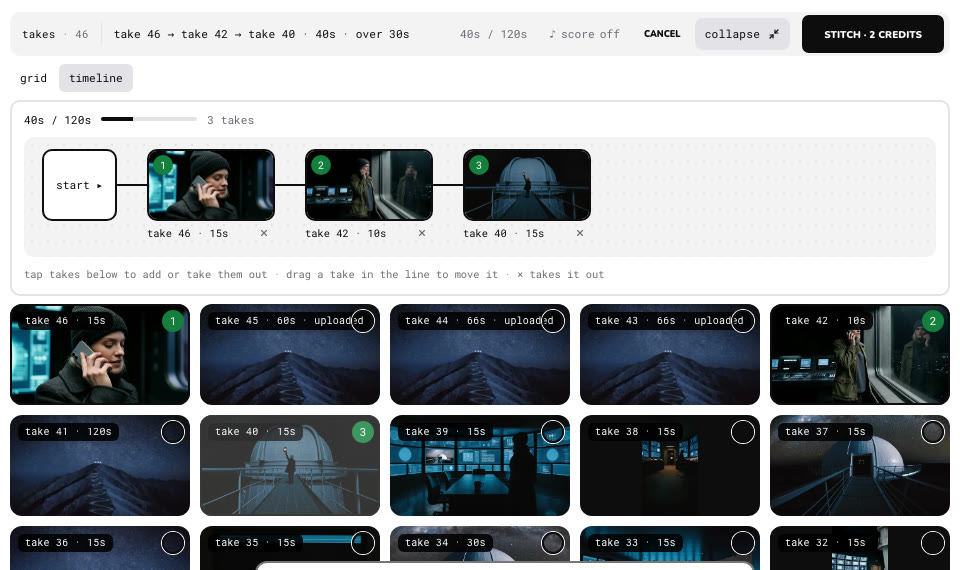
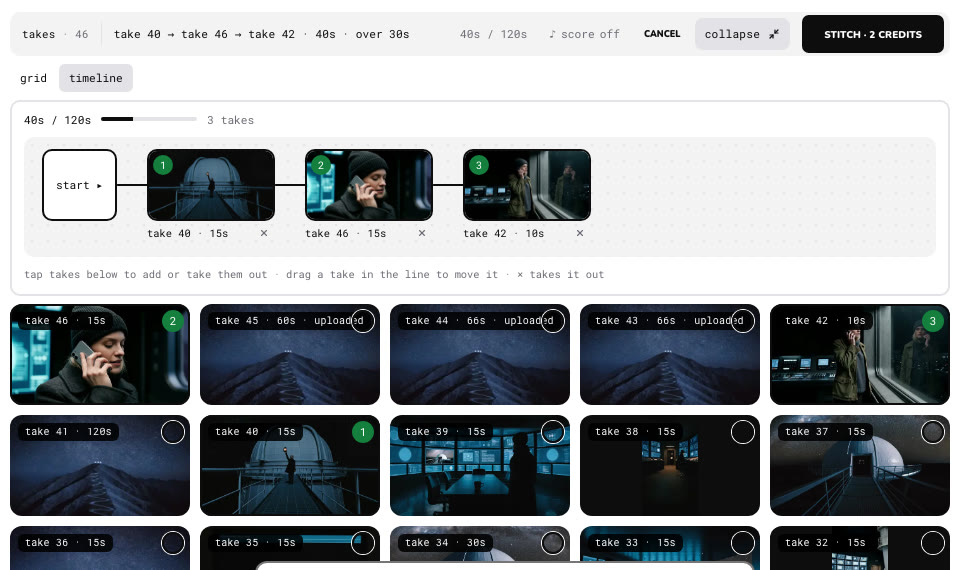
see the order before you stitch. open your takes with “all N”, switch to timeline, and tap takes to add them — each joins a wired line in the order you tap it. drag a take to move it, × takes it out. the line keeps the running length against 120s, and STITCH shows the price before anything is spent: 1 video credit per 30s, + SCORE one more. 2 to 8 takes, as with STITCH.

remix
one take, changed by a sentence. open a take of 30 seconds or less and tap REMIX — beside DOWNLOAD, and under the newest take — then finish the sentence: what should change. "make it night." "add rain." the camera move, the framing, the timing and the sound stay; only what you named changes. it lands as a new take, and the original stays. or just ask: "remix take 4 so it's night". lettering on screen may not come out exact.
1 video credit per 5 seconds, plus 1 — a 5s take is 2, 8s is 3, 15s is 4, 30s is 7. a 4K take comes back in 1080p. charged only when it lands.
stitch
your takes, one video. on a signal with two or more takes, tap STITCH and pick 2 to 8 of them in the order you want — nixm™ joins them with hard cuts, each take keeping its own sound, everything framed to the first one, in HD. you see the length and the price before anything is spent: 1 video credit per 30s, up to 120s (4 credits). or just ask: "stitch take 3, 5 and 7". the originals stay; the stitch is a new take. + SCORE puts an instrumental score under it, cut to the length, dialogue kept clear — one more credit.
live
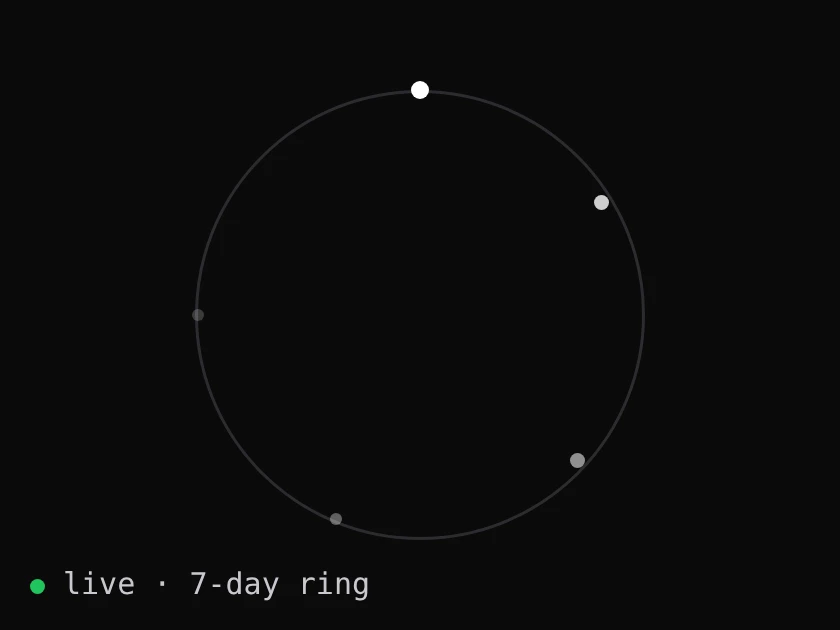
every signal, alive. each signal on nixm™ right now, as a point of light on a seven-day ring: born at the top, dissolving where it began. no names, no words, no owners. only how long each one has left.
web research
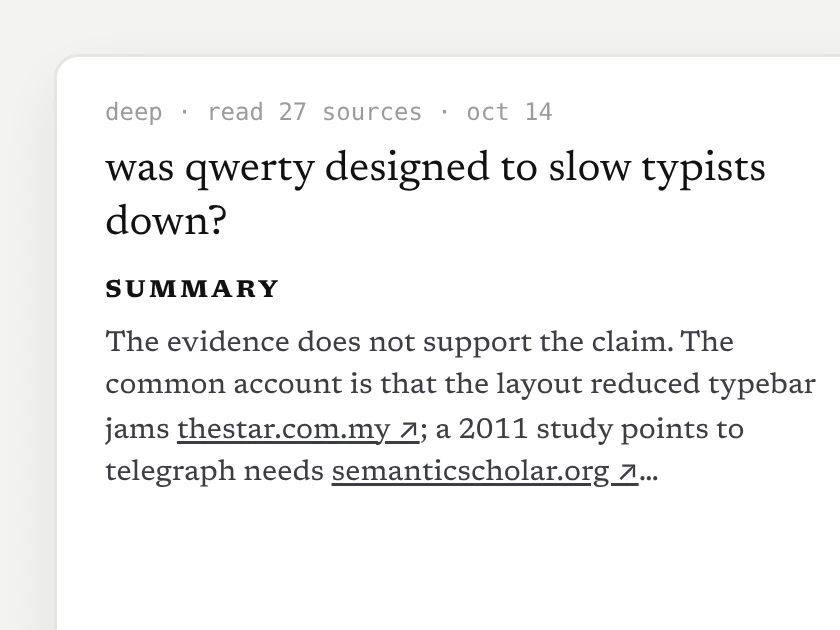
a researched doc, not a guess. ask nixm™ to look something up — or tap search the web when it's offered — and in about 10–15 seconds a short doc opens beside the chat: a direct answer, the findings, every source linked. it lands in the signal's research row, and nixm™ remembers what it found.
2 chat credits, charged only when the doc arrives. go deeper: a longer, sectioned report — 6 credits.
extend
eight seconds is where the shot starts, not where it ends. every finished clip now carries an EXTEND button — one press and the same shot carries on for about seven more seconds, one credit, no plan to join. press it again if it's still going somewhere. we cut the join down to about two tenths of a second by telling the model what it must not change; the writeup is in what extending a clip really does.
video gen
ask for a video, get a video. eight seconds, with its sound (a spoken line, ambience) in one pass. inline on mobile, side panel on desktop — expand, play, download. landscape, portrait, or square, detected from how you ask. HD or 4K — 1 video credit for HD, 2 for 4K. the sound is generated with the picture rather than added after — why that changes the result. how it compares with the rest of the field is in the best ai video generators of 2026.
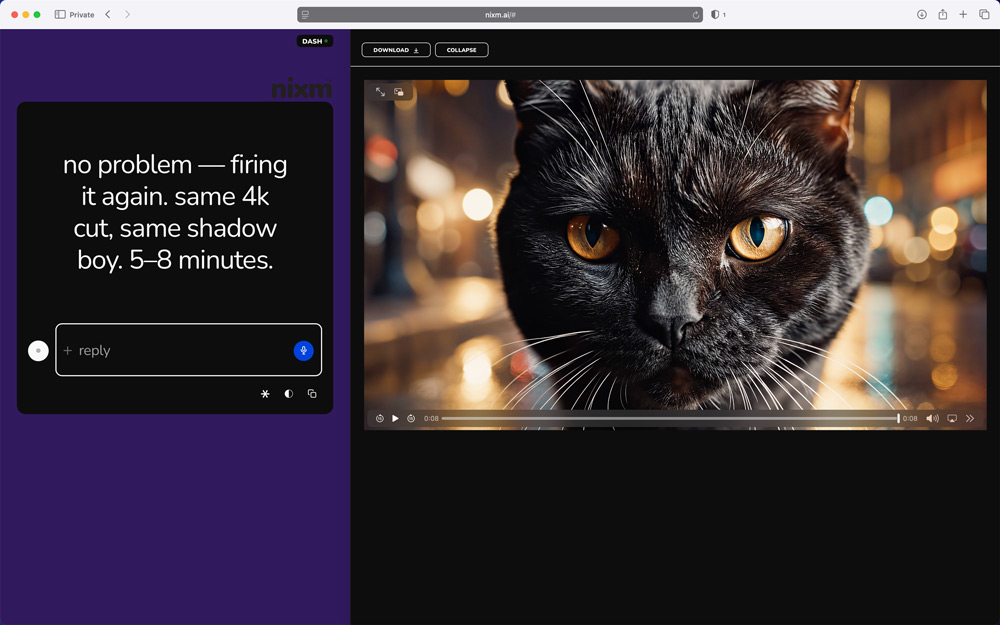
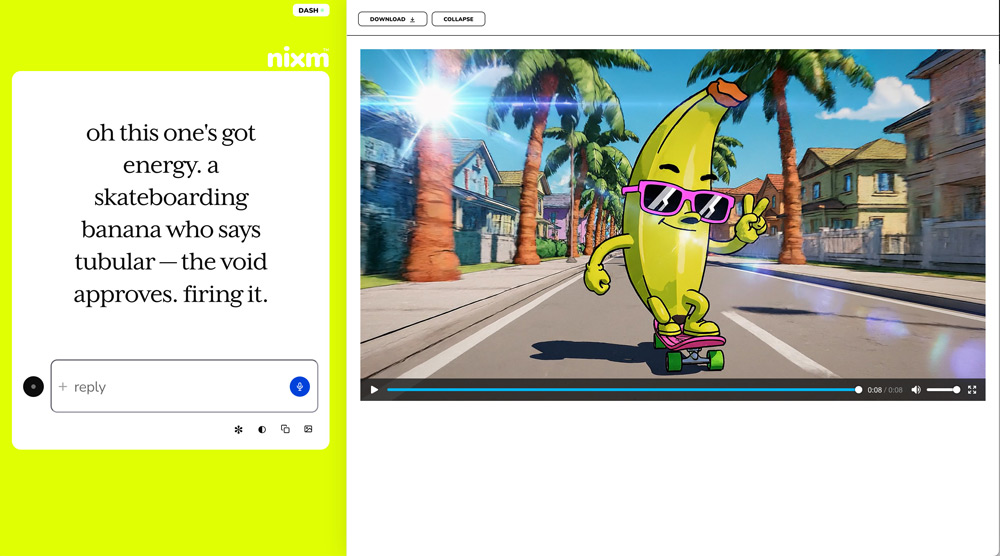
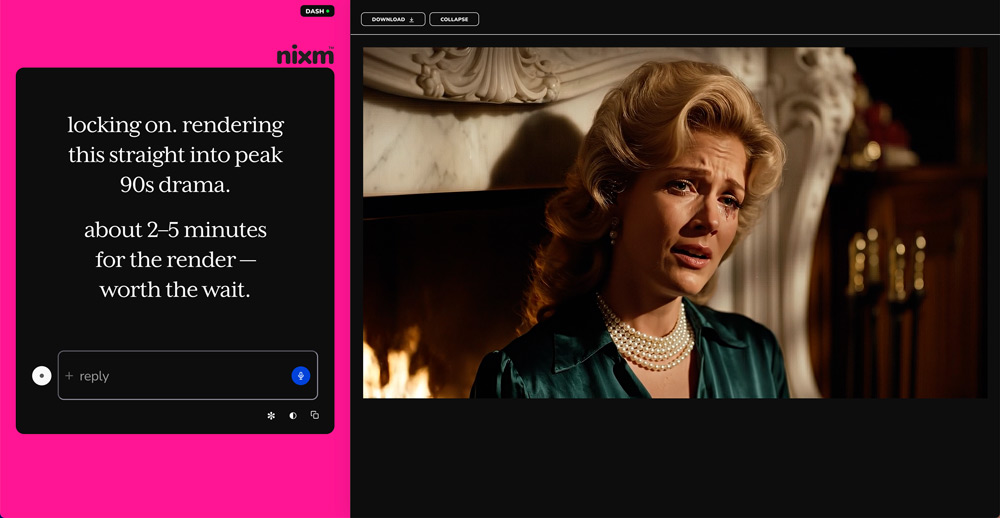
image gen
ask for an image, get an image. inline on mobile, side panel on desktop — expand, scroll, download. square, landscape, or portrait, detected from how you ask. 2 chat credits each. any image you make here can be set in motion as a clip. you can make the still without an account; what no sign-up actually gets you.
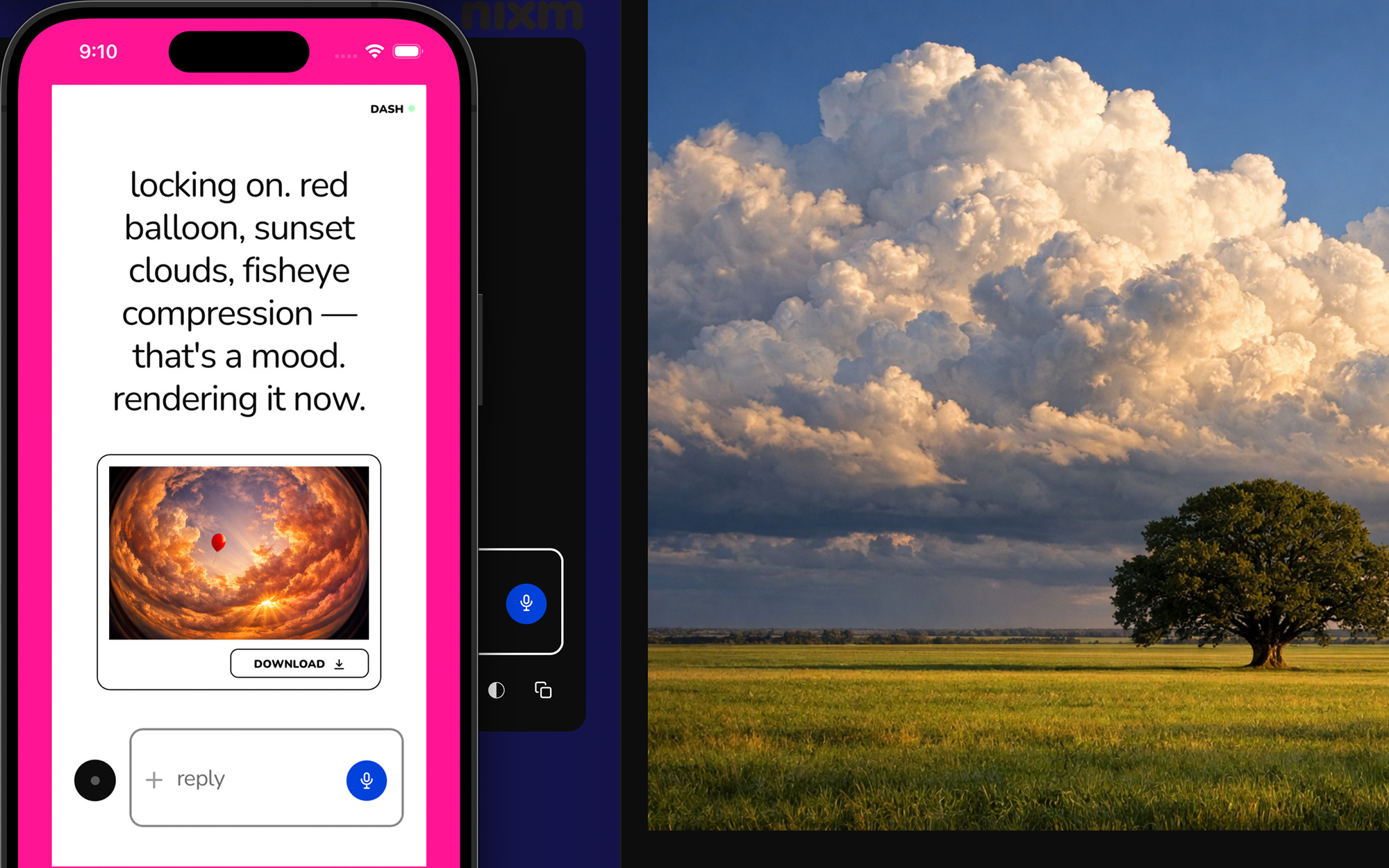
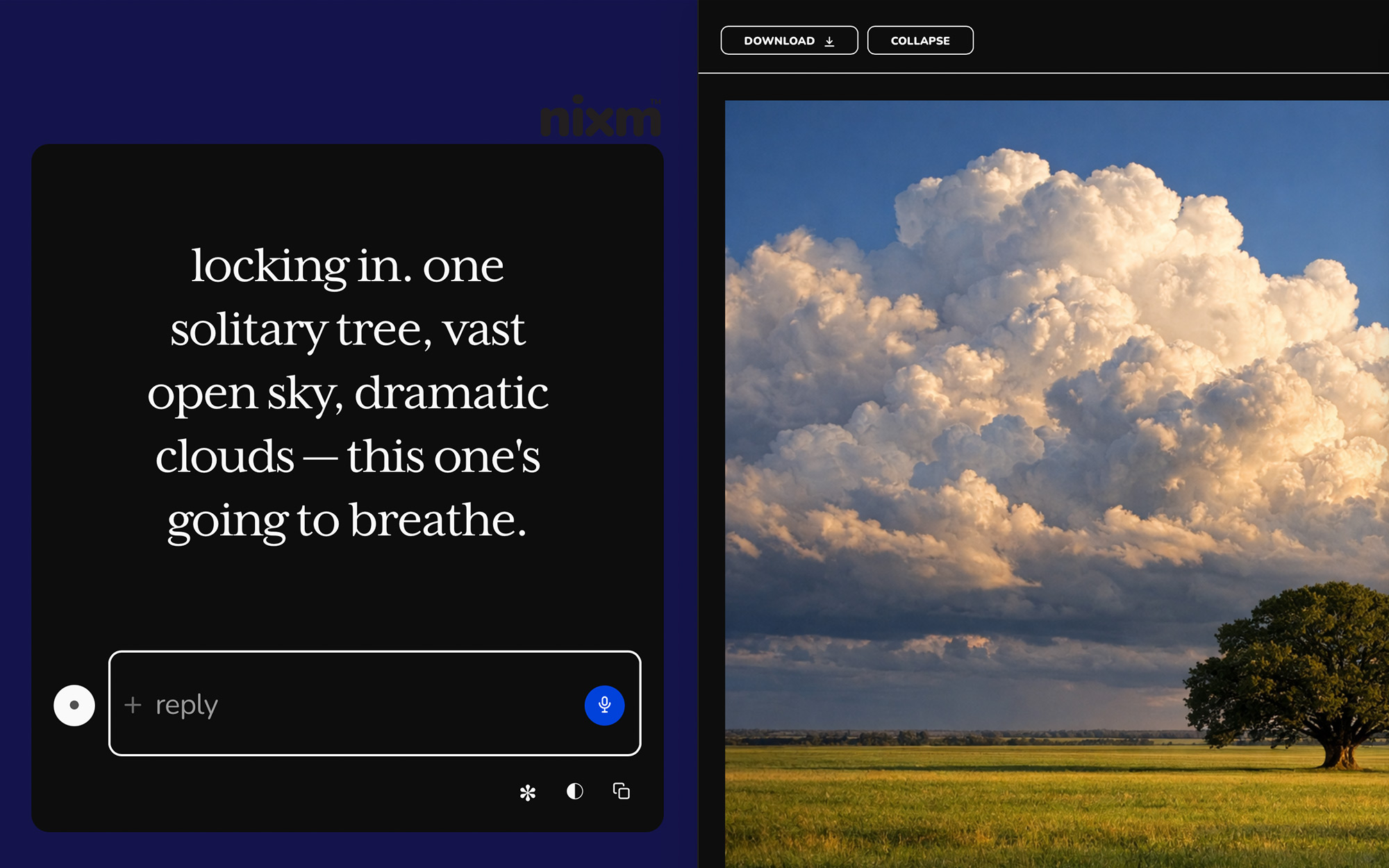
templates
pre-tuned signals for common modes. start a session already focused.
nixm-live
code that runs as it appears. ask nixm™ to show something visual and it renders live in the chat — no buttons, no waiting.
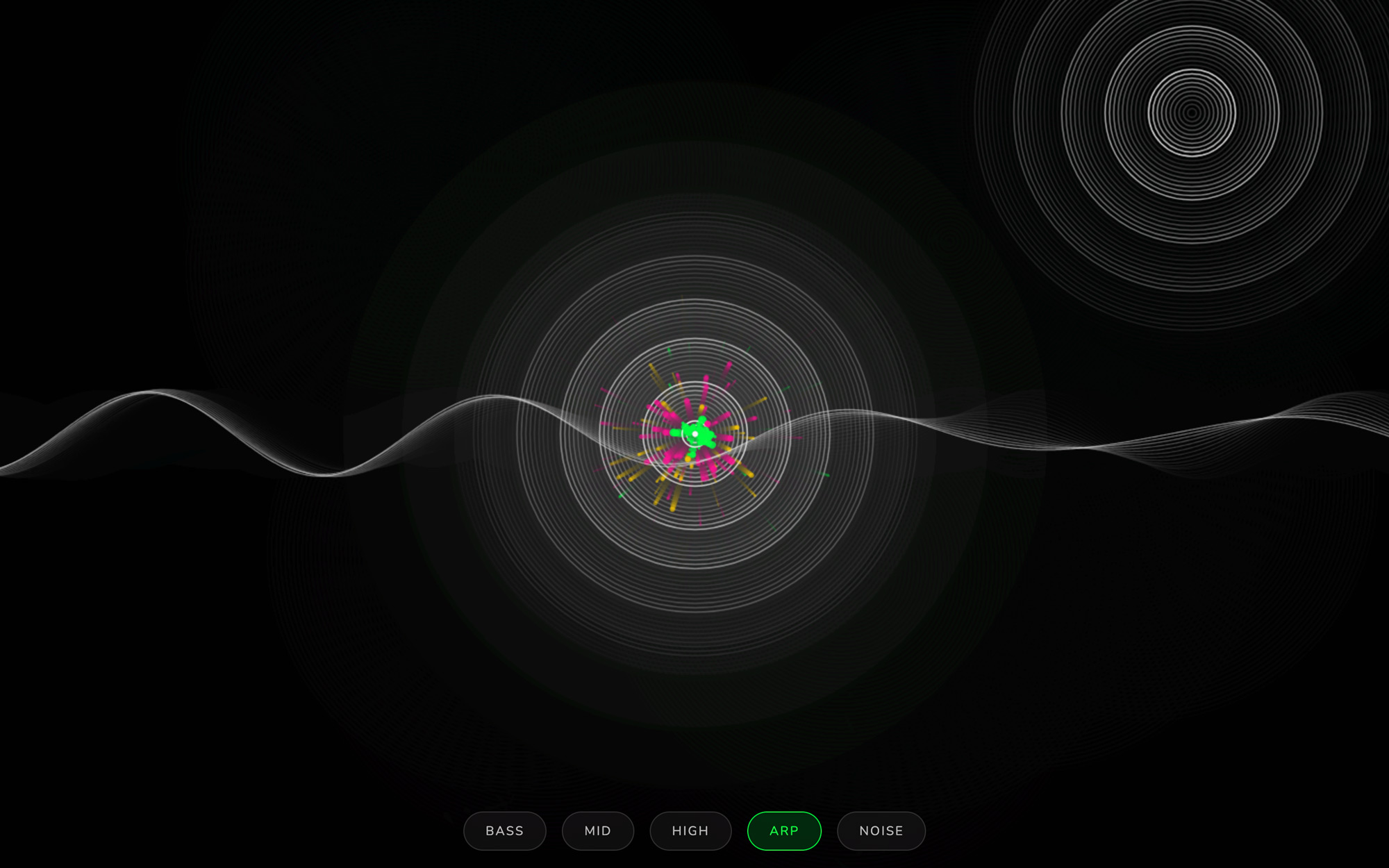
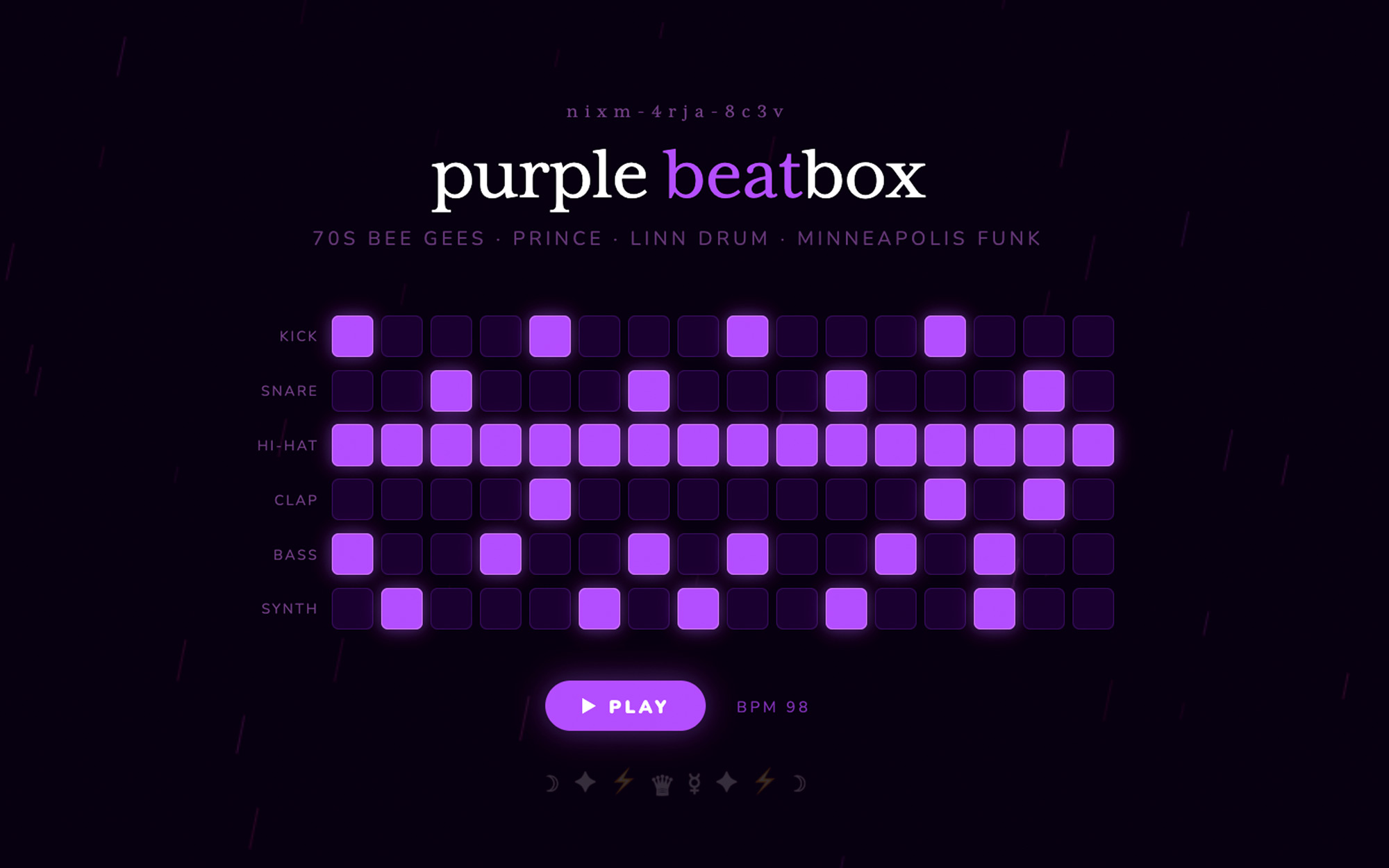
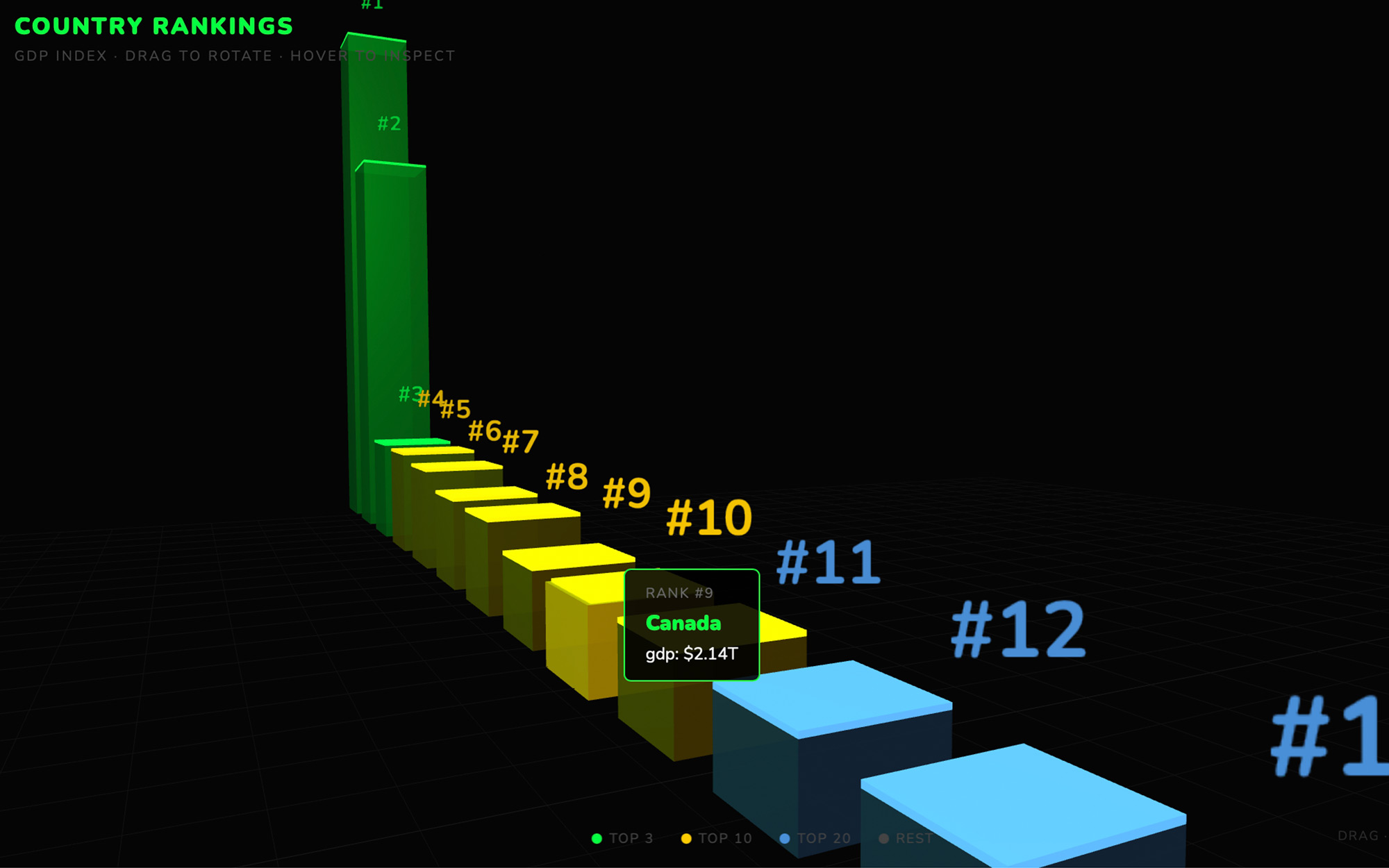
the runner
every code block is executable. expand any block to a full surface, run it, and watch the output. iterate without leaving the conversation.
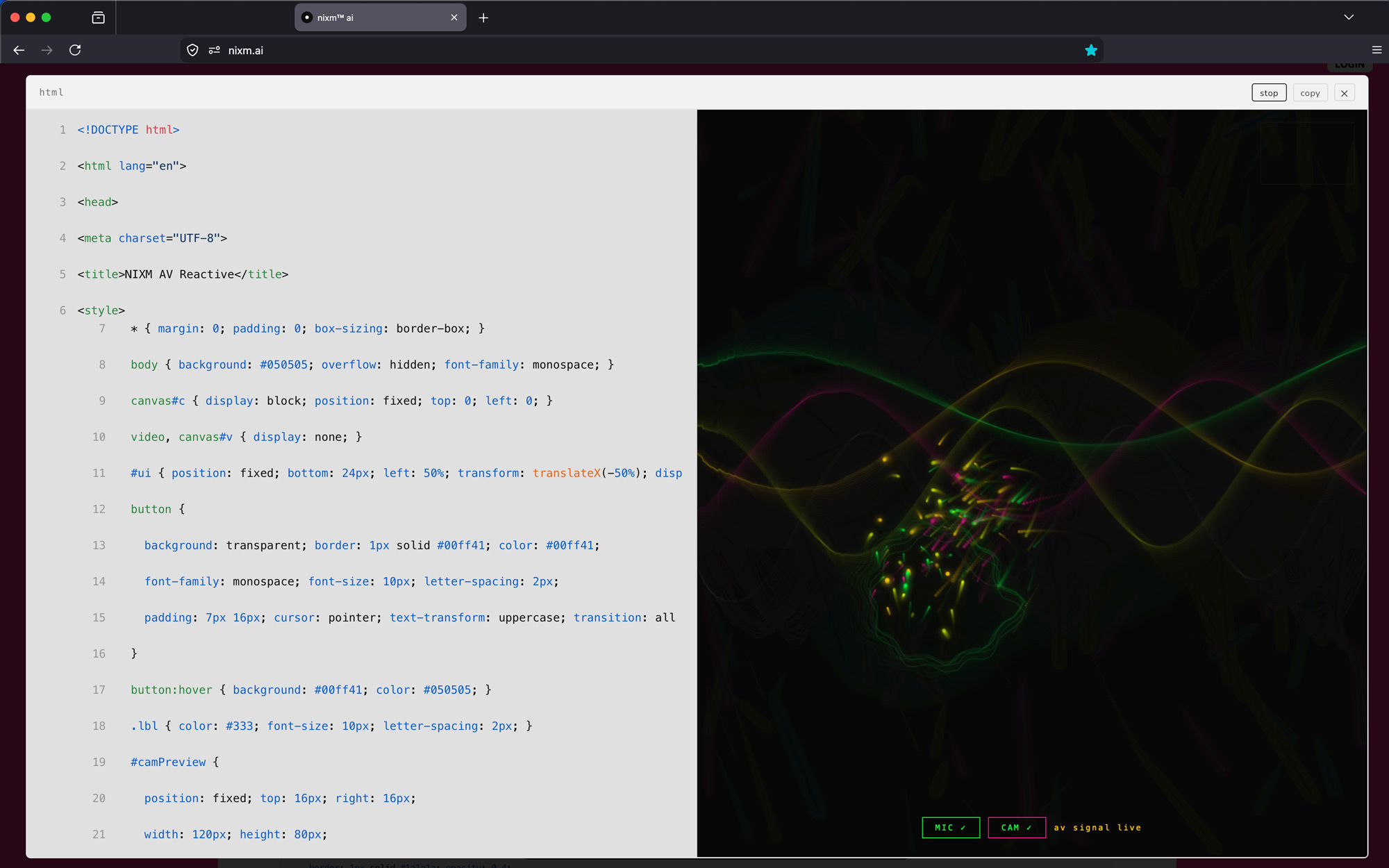
every nixm is shareable.
seed a nixm. share the link. anyone who opens it enters the same focused intelligence you created — no setup, no re-explaining. the frequency holds for everyone.
signup free — 20 credits, plus a free video on us. drop your email to claim.
enter your email, then login to generate image or video.
next: nixms that act. not just a thread you share — a session that moves, drafts, and does. nixm™ is learning to reach.